The tables have turned on Hermia.
She is no longer the object of Lysander and Demetrius' desires, thanks to Puck's mischief.
Poor Hermia discovers that both Lysander and Demetrius suddenly love Helena, and not her.
Hermia
What love could press Lysander from my side?
Lysander
Lysander's love, that would not let him bide:
Fair Helena, who more engilds the night
Than all yon fiery oes and eyes of light.
Why seek'st thou me? Could not this make thee know
The hate I bear thee made me leave thee so?
Hermia
You speak not as you think. It cannot be.
(III, II, 185- 191)
The same man who eloped with her into the forest has now rescinded his love from her.
Meanwhile, Hermia is confused about all this sudden attention she is getting from Lysander and Demetrius, especially because neither of them were interested in her before this "fateful" night. Hermia thinks that Helena is part of this "false sport" at Hermia's expense. Hermia accuses Helena of destroying their friendship:
Oh, is all forgot?
All schooldays' friendship, childhood innocence?
We, Hermia, like two artificial gods,
Have with our needles created both one flower...
As is our hands, our sides, voices, and minds
Had been incorporate. So we grew together,
Like a double cherry - seemingly parted
but yet an union in partition...
And will you rend our ancient love asunder
To join with men in scorning your poor friend?
(III, II, 201-216)
Both girls have misunderstood the other's intentions, and both accuse the other of plotting against them. Lysander and Demetrius aggravate the argument by calling Helena all sorts of derogatory names regarding her dark hair, such as "Eithiope" and "Tartar."
The girls soon turn on each other.
Hermia calls Helena a "juggler! You canker-blossom! You thief of love!" (III, II, 282-283).
Helena strikes back by calling Hermia a "counterfeit, you puppet, you!" (III, II, 288).
Soon the girls are in a Shakespearean catfight!
They insult each other endlessly. Helena calls Hermia a little vixen. Hermia makes fun of Helena's height. They basically want to make each other feel deflated and insecure.
Again, Lysander and Demetrius do not make matters any better, when they cruelly tease Hermia about being a dwarf, and generally treating her like dirt.
Eventually Helena runs away, and Hermia exits, dumbfounded by the event.
Monday, November 30, 2009

Sunday, November 29, 2009
Favorite Quotes from Act II
 Fairy:
Over hill, over dale,
Through bush, through briar,
Over park, over pale,
Through flood, through fire,
I do wander everywhere
Swifter than the moon's sphere,
And I serve the Fairy Queen
To dew her orbs upon the green.
The cowslips tall her pensioners be.
In their gold coats spots you see.
Those be rubies, fairy favors.
In those freckles live their savors.
I must go seek some dewdrops here
And hang a pearl in every cowslip's ear.
Farewell, thou lob of spirits. I'll be gone.
Our Queen and all her elves come here anon.
(II, I, 2-17).
I love the imagery in this opening part of Act II. Can't you just imagine little fairies running around planting rubies in flowers and hanging dewy pearls in cowslips in the early evening? I think it is adorable.
First Fairy:
[sings] You spotted snakes with double tongue,
Thorny hedgehogs, be not seen.
Newts and blindworms, do no wrong.
Come not near our Fairy Queen.
(II, II, 9-12).
Again, this Act is full of fabulous imagery. I love the image of little fairies singing songs to protect their mistress from creepy things in the night.
Favorite Quotes from Act I
I love A Midsummer Night's Dream so far, so I thought I would share my favorite quotes from the first Act.
Hermia:
By all the vows that ever men have broke
(In number more than ever women spoke),
In that same place thou hast appointed me,
Tomorrow truly will I meet with thee.
(I, I, 175-178).
I thought that this quote was humorous, because I felt like Hermia was being a little bitter referencing all the vows that men have broken compared to the number that women have spoken. She is angry and frustrated with her father, and I think she is warning Lysander that their elopement is a very dangerous idea, and if he falls through with his promise, she will never forgive him.
Helena
O, were favor so,
Yours I would catch, fair Hermia, ere I go.
My ear should catch your voice. My eye, your eye.
My tongue should catch your tongue's sweet melody.
Were the world mine, Demetrius being bated,
The rest I'd give to be to you translated.
Oh, teach me how you look and with what art
You saw the motion of Demetrius' heart.
(I, I, 186-193).
I can just feel Helena's desperation jumping off the page. All she wants is for Demetrius to love her, and she feels that she needs to be just like Hermia for him to love her. I feel sorry for her. I think she is the character in the play that exemplifies the frustration of teenage love and experiences. I also feel that she is the most "human."
A Magical Flower
The folklore behind Midsummer Night is filled with superstitions and magic. The moon is full, and the sun is at its highest. It is believed that on the night before the summer solstice, plants are granted very magical powers. This idea comes from Greek astrology, Druid sun worship, and Christianity's belief in healing through faith. This night is marked as St. John's Eve by the church calender, which proves to be interesting. Medicinal plants were prominent in the daily life of Shakespeare's time, and Shakespeare used the popular folklore to his advantage.
In Act II, Oberon instructs Puck to drop the juice from a flower called "love-in-idleness" on Titania's eyelids, so she wakes to fall in love with the first thing she sees. After Oberon witnesses Demetrius and Helena fighting, he also instructs Puck to use the flower's juice on Demetrius while he is sleeping, who he "will know the man by the Athenian garments he hath on" (II, I, 265-266). Unfortunately, Puck mistakes Lysander for Demetrius, so when Lysander awakens and sees Helena, he no longer loves Hermia, who he eloped with. In Act III, Oberon squeezes the flower's juice in Demetrius' eye, so he will fall in love with Helena when he wakes up and sees her. The Fairy King and his servant apparently are arranging this for sport:
Then will two at once woo one.
That must needs be sport alone.
And those things do best please me
That befall preposterously.
(III, II, 118-121).
Chaos ensues. And all because of a little magical flower and mischievous fairies.
I thought that the origins of that magical flower were interesting. Apparently, according to Lou Agnes Reynolds and Paul Sawyer, the flower is an allusion to a herb called St. John's Wort. Midsummer Night was marked by the church as a celebration of John the Baptist's birth. The plant associated with John the Baptist, St. John's Wort, would gain magical powers on the night.
Here is a picture of St. John's Wort:

St. John's Wort is yellow.
According to Oberon, the magical flower is purple from a bolt from Cupid. A Midsummer Night's Dream takes place in pre-Christianity Athens, so that reference makes sense:
Yet marked I where the bolt of Cupid fell.
It fell upon a little western flower,
Before milk-white, now purple with love's wound,
And maidens call it "love-in-idleness."
Fetch me that flower...
(II,I, 177-179).
According to this description, the flower should look more like this:

It is still possible that the allusion between St. John's Wort and Oberon's flower exists because both flowers gain magical powers on Midsummer Night. Also, St. John's Wort has been used as a medicinal remedy for hundreds of years, so the people of Shakespeare's time would have been familiar with the plant. Shakespeare may have also used the legend of Cupid to enforce the Athenian setting.
Regardless of what the flower is supposed to look like, Shakespeare successfully blended the real with the mythical by refrencing familiar remedies and magical legends. By doing so, he enhanced his story by using plants as a halfway point between reality and fantasy.
In Act II, Oberon instructs Puck to drop the juice from a flower called "love-in-idleness" on Titania's eyelids, so she wakes to fall in love with the first thing she sees. After Oberon witnesses Demetrius and Helena fighting, he also instructs Puck to use the flower's juice on Demetrius while he is sleeping, who he "will know the man by the Athenian garments he hath on" (II, I, 265-266). Unfortunately, Puck mistakes Lysander for Demetrius, so when Lysander awakens and sees Helena, he no longer loves Hermia, who he eloped with. In Act III, Oberon squeezes the flower's juice in Demetrius' eye, so he will fall in love with Helena when he wakes up and sees her. The Fairy King and his servant apparently are arranging this for sport:
Then will two at once woo one.
That must needs be sport alone.
And those things do best please me
That befall preposterously.
(III, II, 118-121).
Chaos ensues. And all because of a little magical flower and mischievous fairies.
I thought that the origins of that magical flower were interesting. Apparently, according to Lou Agnes Reynolds and Paul Sawyer, the flower is an allusion to a herb called St. John's Wort. Midsummer Night was marked by the church as a celebration of John the Baptist's birth. The plant associated with John the Baptist, St. John's Wort, would gain magical powers on the night.
Here is a picture of St. John's Wort:
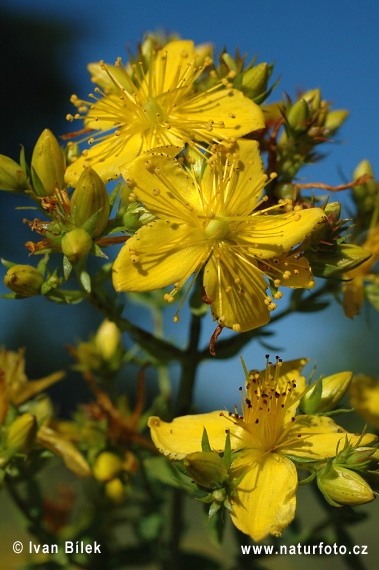
St. John's Wort is yellow.
According to Oberon, the magical flower is purple from a bolt from Cupid. A Midsummer Night's Dream takes place in pre-Christianity Athens, so that reference makes sense:
Yet marked I where the bolt of Cupid fell.
It fell upon a little western flower,
Before milk-white, now purple with love's wound,
And maidens call it "love-in-idleness."
Fetch me that flower...
(II,I, 177-179).
According to this description, the flower should look more like this:

It is still possible that the allusion between St. John's Wort and Oberon's flower exists because both flowers gain magical powers on Midsummer Night. Also, St. John's Wort has been used as a medicinal remedy for hundreds of years, so the people of Shakespeare's time would have been familiar with the plant. Shakespeare may have also used the legend of Cupid to enforce the Athenian setting.
Regardless of what the flower is supposed to look like, Shakespeare successfully blended the real with the mythical by refrencing familiar remedies and magical legends. By doing so, he enhanced his story by using plants as a halfway point between reality and fantasy.
Wednesday, November 25, 2009
Imagery...

- Over hill, over dale,
- Thorough bush, thorough brier,
- Over park, over pale,
- Thorough flood, thorough fire,
- I do wander everywhere,
- Swifter than the moon's sphere;
- And I serve the fairy queen,

- To dew her orbs upon the green.
- The cowslips tall her pensioners be:
- In their gold coats spots you see;
- Those be rubies, fairy favours,
- In those freckles live their savours;
- I must go seek some dew-drops here,
- And hang a pearl in every cowslip's ear.
- Farewell, thou lob of spirits; I'll be gone:
- Our queen and all her elves come here anon.

PUCK
- The king doth keep his revels here to-night;
- Take heed the Queen come not within his sight.
- For Oberon is passing fell and wrath,

- Because that she, as her attendant, hath
- A lovely boy, stol'n from an Indian king;
- She never had so sweet a changeling:
- And jealous Oberon would have the child
- Knight of his train, to trace the forests wild:
- But she perforce withholds the loved boy,
- Crowns him with flowers, and makes him all her joy:
- And now they never meet in grove or green,
- By fountain clear, or spangled starlight sheen,
- But they do square; that all their elves for fear
- Creep into acorn cups, and hide them there.

FAIRY
- Either I mistake your shape and making quite,
- Or else you are that shrewd and knavish sprite
- Call'd Robin Goodfellow: are not you he
- That frights the maidens of the villagery;
- Skim milk, and sometimes labour in the quern,
- And bootless make the breathless housewife churn;
- And sometime make the drink to bear no barm;
- Mislead night-wanderers, laughing at their harm?

- Those that Hobgoblin call you, and sweet Puck,
- You do their work, and they shall have good luck:
- Are not you he?

PUCK
- Thou speak'st aright;
- I am that merry wanderer of the night.
- I jest to Oberon, and make him smile,
- When I a fat and bean-fed horse beguile,
- Neighing in likeness of a filly foal;
- And sometime lurk I in a gossip's bowl,
- In very likeness of a roasted crab;

- And, when she drinks, against her lips I bob,
- And on her withered dewlap pour the ale.
- The wisest aunt, telling the saddest tale,
- Sometime for three-foot stool mistaketh me;
- Then slip I from her bum, down topples she,
- And 'tailor' cries, and falls into a cough;
- And then the whole quire hold their hips and loffe,
- And waxen in their mirth, and neeze, and swear
- A merrier hour was never wasted there.—
- But room, fairy, here comes Oberon.

Saturday, November 21, 2009
Hermia in Love
Helena is the epitome of frustrated love.
In Athens she is known to be just as beautiful as Hermia, but the man she loves only has eyes for the fair Hermia. Even though Demetrius loves Hermia and cares nothing for Helena, Helena does not hate Hermia, but rather is envious of her beauty. She muses “Were the world mine…teach me how you look and with what art you saw the motion of Demetrius’ heart” (190-193).
Helena and Hermia are good friends from childhood, and Hermia trys to explain to Helena that she does not know why Demetrius is in love with her:
HERMIA: I frown upon him, yet he loves me still.
HELENA: O that your frowns would teach my smiles such skill!
HERMIA: I give him curses, yet he gives me love.
HELENA: O that my prayers could such affection move!
HERMIA: The more I hate, the more he follows me.
HELENA: The more I love, the more he hateth me.
HERMIA: His folly, Helena, is no fault of mine.
HELENA: None, but your beauty: would that fault were mine!
HERMIA: Take comfort: he no more shall see my face;
Lysander and myself will fly this place.
In this passage, both girls are frustrated with Demetrius, but Helena is more agonized than Hermia. Hermia tries to console Helena, but she is not too concerned with Helena’s situation. Lysander and Hermia are too caught up in their own love to take real action against Helena’s plight. When together, the explain the details of their elopement to Helena, but quickly desert her in the forest, too full of excitement. Before they depart, Lysander tells Helena “As you on him, Demetrius dote on you!” (225). This is just wishful thinking, and pleasantry and Helena knows it. Her solioquoy shows her epic frustration:
How happy some o'er other some can be!
Through Athens I am thought as fair as she.
But what of that? Demetrius thinks not so;
He will not know what all but he do know:
And as he errs, doting on Hermia's eyes,
So I, admiring of his qualities:
Things base and vile, folding no quantity,
Love can transpose to form and dignity:
Love looks not with the eyes, but with the mind;
And therefore is wing'd Cupid painted blind:
Nor hath Love's mind of any judgement taste;
Wings and no eyes figure unheedy haste:
And therefore is Love said to be a child,
Because in choice he is so oft beguiled.
As waggish boys in game themselves forswear,
So the boy Love is perjured every where:
For ere Demetrius look'd on Hermia's eyne,
He hail'd down oaths that he was only mine;
And when this hail some heat from Hermia felt,
So he dissolved, and showers of oaths did melt.
I will go tell him of fair Hermia's flight:
Then to the wood will he to-morrow night
Pursue her; and for this intelligence
If I have thanks, it is a dear expense:
But herein mean I to enrich my pain,
To have his sight thither and back again.
Helena laments that even though the city of Athens thinks that Helena and Hermia are of comparable beauty, Demetrius “thinks not so; He will not know what all but he do know.” Demetrius refuses to acknowledge that Hermia and Helena are equally attractive, which further frustrates poor Helena.
Helena also bitterly states that love is “wing’d Cupid painted blind…Wings and no eyes figure unheedy haste: because in choice he is so oft beguiled.” She accuses Cupid of acting recklessly when misleading people into love, because love “looks not with the eyes, but with the mind.” In this passage, Helena thinks that Demetrius has created Hermia to be a fantastical woman, and that the Hermia he has fallen in love with actually does not exist.
Helena more plainly explains her frustration with Demetrius. Apparently he hailed oaths that his love only belonged to Helena, but once he met Hermia, his love was “dissolved.” I think that Demetrius is stubborn and worthless. What does Hermia have that Helena does not? They are both beautiful, and of the same status. What was so mesmerizing about Hermia to make Demetrius forget Helena? Shakespeare may be demonstrating the fickleness of love, and how quickly people change their minds. The human heart and mind are very dynamic.
Finally, Helena confesses in her soliloquy that grudging thanks from Demetrius will make her happy, because she will “have his sight thither and back again.” She decides to tell Demetrius of Hermia’s elopement, possibly sacrificing her friend’s happiness for a glance from Demetrius.
I would like to know what Demetrius is thinking throughout this act. Is he pushing Helena away because he is so stricken with love for Hermia, or is he pushing her away because her persistence scares him? Ironically, Demetrius is pushing Helena away like Hermia is pushing him away. It is possible that he is taking his frustration out on Helena.
In Athens she is known to be just as beautiful as Hermia, but the man she loves only has eyes for the fair Hermia. Even though Demetrius loves Hermia and cares nothing for Helena, Helena does not hate Hermia, but rather is envious of her beauty. She muses “Were the world mine…teach me how you look and with what art you saw the motion of Demetrius’ heart” (190-193).
Helena and Hermia are good friends from childhood, and Hermia trys to explain to Helena that she does not know why Demetrius is in love with her:
HERMIA: I frown upon him, yet he loves me still.
HELENA: O that your frowns would teach my smiles such skill!
HERMIA: I give him curses, yet he gives me love.
HELENA: O that my prayers could such affection move!
HERMIA: The more I hate, the more he follows me.
HELENA: The more I love, the more he hateth me.
HERMIA: His folly, Helena, is no fault of mine.
HELENA: None, but your beauty: would that fault were mine!
HERMIA: Take comfort: he no more shall see my face;
Lysander and myself will fly this place.
In this passage, both girls are frustrated with Demetrius, but Helena is more agonized than Hermia. Hermia tries to console Helena, but she is not too concerned with Helena’s situation. Lysander and Hermia are too caught up in their own love to take real action against Helena’s plight. When together, the explain the details of their elopement to Helena, but quickly desert her in the forest, too full of excitement. Before they depart, Lysander tells Helena “As you on him, Demetrius dote on you!” (225). This is just wishful thinking, and pleasantry and Helena knows it. Her solioquoy shows her epic frustration:
How happy some o'er other some can be!
Through Athens I am thought as fair as she.
But what of that? Demetrius thinks not so;
He will not know what all but he do know:
And as he errs, doting on Hermia's eyes,
So I, admiring of his qualities:
Things base and vile, folding no quantity,
Love can transpose to form and dignity:
Love looks not with the eyes, but with the mind;
And therefore is wing'd Cupid painted blind:
Nor hath Love's mind of any judgement taste;
Wings and no eyes figure unheedy haste:
And therefore is Love said to be a child,
Because in choice he is so oft beguiled.
As waggish boys in game themselves forswear,
So the boy Love is perjured every where:
For ere Demetrius look'd on Hermia's eyne,
He hail'd down oaths that he was only mine;
And when this hail some heat from Hermia felt,
So he dissolved, and showers of oaths did melt.
I will go tell him of fair Hermia's flight:
Then to the wood will he to-morrow night
Pursue her; and for this intelligence
If I have thanks, it is a dear expense:
But herein mean I to enrich my pain,
To have his sight thither and back again.
Helena laments that even though the city of Athens thinks that Helena and Hermia are of comparable beauty, Demetrius “thinks not so; He will not know what all but he do know.” Demetrius refuses to acknowledge that Hermia and Helena are equally attractive, which further frustrates poor Helena.
Helena also bitterly states that love is “wing’d Cupid painted blind…Wings and no eyes figure unheedy haste: because in choice he is so oft beguiled.” She accuses Cupid of acting recklessly when misleading people into love, because love “looks not with the eyes, but with the mind.” In this passage, Helena thinks that Demetrius has created Hermia to be a fantastical woman, and that the Hermia he has fallen in love with actually does not exist.
Helena more plainly explains her frustration with Demetrius. Apparently he hailed oaths that his love only belonged to Helena, but once he met Hermia, his love was “dissolved.” I think that Demetrius is stubborn and worthless. What does Hermia have that Helena does not? They are both beautiful, and of the same status. What was so mesmerizing about Hermia to make Demetrius forget Helena? Shakespeare may be demonstrating the fickleness of love, and how quickly people change their minds. The human heart and mind are very dynamic.
Finally, Helena confesses in her soliloquy that grudging thanks from Demetrius will make her happy, because she will “have his sight thither and back again.” She decides to tell Demetrius of Hermia’s elopement, possibly sacrificing her friend’s happiness for a glance from Demetrius.
I would like to know what Demetrius is thinking throughout this act. Is he pushing Helena away because he is so stricken with love for Hermia, or is he pushing her away because her persistence scares him? Ironically, Demetrius is pushing Helena away like Hermia is pushing him away. It is possible that he is taking his frustration out on Helena.
Sunday, November 15, 2009
Love is in the air...

Theseus loves Hippolyta.
Hermia loves Lysander.
Demetrius loves Hermia.
It is all very confusing.
Egeus, Hermia's father, disapproves of Lysander, and wants Hermia to marry Demetrius. He requests Theseus' counsel on the marriage situation. Theseus, the confident duke of
Either to die the death or to abjure
forever the society of men.
Therefore Hermia, question your desires,
know of you youth, examine well your blood (Act I, Scene I, 65-68).
At first I thought this advice was too severe and seemed out of place in a scene filled with characters in love, but as I continued to read the scene, Shakespeare's possible motive became clear.
Theseus, Hermia, Lysander, Demetrius, and Helena are all in love, and Shakespeare uses them to prove that love is not just a passing fancy, but has immense control on how people react and how they confront the realities of life. Hermia and Lysander love each other, and when confronted with the possibility of death or separation from each other forever, they decide to hide in a forest together. Whether such an action is rational or not, their actions show that love can render people blind to the future, and can cause them to only think short term. Stealing away to the forest can give the wrong impression to others, and can ruin their reputations, especially Hermia's reputation. However, they think they are irrevocably in love with each other, and so they do not allow themselves to think of a world without each other.
Shakespeare also may be criticizing his contemporary society's view on love, and how love was no longer a matter of the heart, but of status and family power. Egeus has a very strong desire to control his daughter, and initially wants her to die if she marries Lysander against his wishes. Even though Theseus advises to reduce the sentence to living in a convent, it is still obvious that Hermia’s opinion matters very little. In Shakespeare’s time, arranged marriages were not uncommon, and were tools to increase a family’s status in society. Love rarely mattered in such arrangements.
Based on the interaction between Lysander, Hermia, Demetrius, and Helena, Shakespeare was quite aware of the complexities of love. The dilemmas that the characters endure are so real. Hermia and Lysander could be any couple that faces opposition, and
The workings of love are going to be very interesting tools for Shakespeare to use in this play.
Sunday, November 8, 2009
An Introduction
Hello!
I have started this blog as part of an independent study project for a Shakespeare class. I have chosen to read A Midsummer Night's Dream. I have seen the movie numerous times, and thought that it was about time to read the actual play.
Instead of simply writing a structured response to each Act, I thought I would respond with my thoughts and any interesting tidbits of information I find as I go along.
My goal is to read the play on a more personal level than I usually read for school, and to enjoy myself along the way.
~ Julia
Hand in hand, with fairy grace,
Will we sing, and bless this place.
~William Shakespeare, A Midsummer Night's Dream
I have started this blog as part of an independent study project for a Shakespeare class. I have chosen to read A Midsummer Night's Dream. I have seen the movie numerous times, and thought that it was about time to read the actual play.
Instead of simply writing a structured response to each Act, I thought I would respond with my thoughts and any interesting tidbits of information I find as I go along.
My goal is to read the play on a more personal level than I usually read for school, and to enjoy myself along the way.
~ Julia
Hand in hand, with fairy grace,
Will we sing, and bless this place.
~William Shakespeare, A Midsummer Night's Dream
Subscribe to:
Posts (Atom)
