In Act II, Oberon instructs Puck to drop the juice from a flower called "love-in-idleness" on Titania's eyelids, so she wakes to fall in love with the first thing she sees. After Oberon witnesses Demetrius and Helena fighting, he also instructs Puck to use the flower's juice on Demetrius while he is sleeping, who he "will know the man by the Athenian garments he hath on" (II, I, 265-266). Unfortunately, Puck mistakes Lysander for Demetrius, so when Lysander awakens and sees Helena, he no longer loves Hermia, who he eloped with. In Act III, Oberon squeezes the flower's juice in Demetrius' eye, so he will fall in love with Helena when he wakes up and sees her. The Fairy King and his servant apparently are arranging this for sport:
Then will two at once woo one.
That must needs be sport alone.
And those things do best please me
That befall preposterously.
(III, II, 118-121).
Chaos ensues. And all because of a little magical flower and mischievous fairies.
I thought that the origins of that magical flower were interesting. Apparently, according to Lou Agnes Reynolds and Paul Sawyer, the flower is an allusion to a herb called St. John's Wort. Midsummer Night was marked by the church as a celebration of John the Baptist's birth. The plant associated with John the Baptist, St. John's Wort, would gain magical powers on the night.
Here is a picture of St. John's Wort:
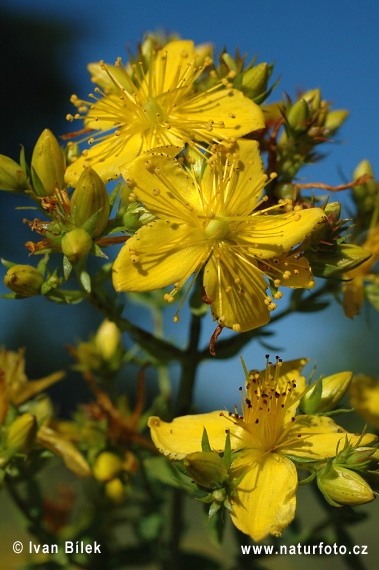
St. John's Wort is yellow.
According to Oberon, the magical flower is purple from a bolt from Cupid. A Midsummer Night's Dream takes place in pre-Christianity Athens, so that reference makes sense:
Yet marked I where the bolt of Cupid fell.
It fell upon a little western flower,
Before milk-white, now purple with love's wound,
And maidens call it "love-in-idleness."
Fetch me that flower...
(II,I, 177-179).
According to this description, the flower should look more like this:

It is still possible that the allusion between St. John's Wort and Oberon's flower exists because both flowers gain magical powers on Midsummer Night. Also, St. John's Wort has been used as a medicinal remedy for hundreds of years, so the people of Shakespeare's time would have been familiar with the plant. Shakespeare may have also used the legend of Cupid to enforce the Athenian setting.
Regardless of what the flower is supposed to look like, Shakespeare successfully blended the real with the mythical by refrencing familiar remedies and magical legends. By doing so, he enhanced his story by using plants as a halfway point between reality and fantasy.


No comments:
Post a Comment